
From Wax Seals to Digital Signatures

John Sherman
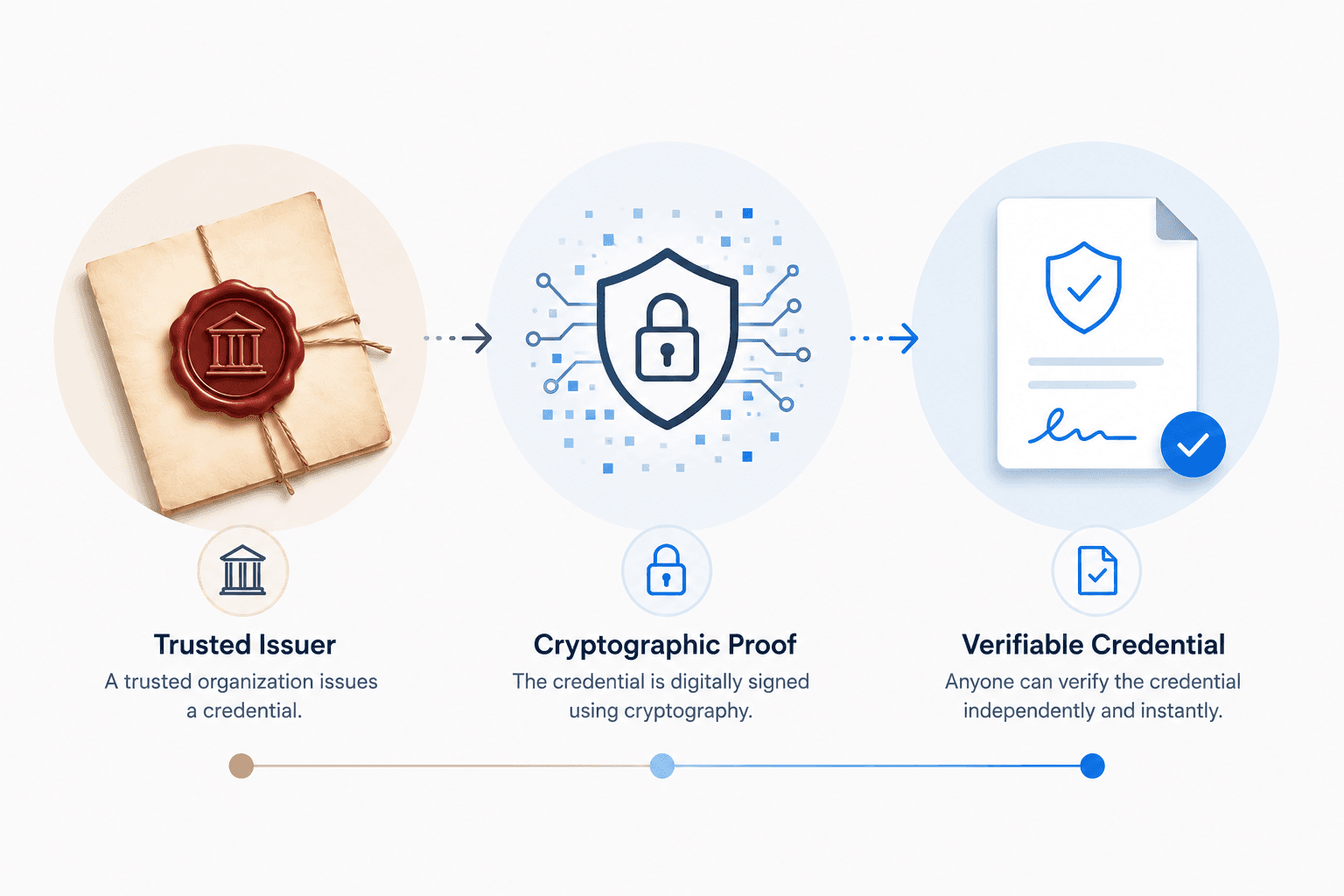
An architectural shift from institutionally mediated trust to decentralized, cryptographically verifiable credentials
From Letters of Trust to Verifiable Credentials
The problem of trust has always been, at its core, a problem of distance.
Economic and social life depend on the ability of individuals and institutions to rely on claims made by others—claims about identity, authority, qualification, or intent. Yet in most cases, these claims must be evaluated in the absence of direct knowledge. The question is not simply whether something is true, but how it can be known to be true by someone who has no prior relationship with the claimant.
For centuries, one of the most effective solutions to this problem has been the credential.
The word itself is revealing. Derived from the Latin credere, meaning “to believe” or “to entrust,” a credential is, in essence, a device for transmitting belief. It allows one party to rely on the judgment of another, even across distance, institutions, or time. In this sense, credentials are not merely administrative artifacts—they are instruments through which trust becomes portable.
The Origins of Portable Trust
Long before digital systems, trust traveled through physical documents.
In medieval and early modern Europe, letters of credential—litterae credenciales—were issued by monarchs, religious authorities, and guilds. These documents attested to the identity or authority of the bearer, enabling them to act in contexts where they would otherwise be unknown. A diplomat could negotiate on behalf of a sovereign; a merchant could gain access to distant markets; a scholar could be received into foreign institutions.
In each case, the credential functioned as a proxy for reputation. The bearer did not need to establish trust from first principles. Instead, they carried it with them, embodied in the authority of the issuer.
Two features made these systems effective. First, the credibility of the issuing institution. Second, the recognizability of the form—seals, signatures, and standardized formats that signaled authenticity. Over time, both dimensions became increasingly formalized, giving rise to the credentialing systems that remain familiar today: passports, diplomas, licenses, and certifications.
These developments expanded the scope of economic and social interaction by reducing the cost of establishing trust between strangers. But they did not fundamentally change how trust was verified.
An architectural shift from institutionally mediated trust to decentralized, cryptographically verifiable credentials
From Letters of Trust to Verifiable Credentials
The problem of trust has always been, at its core, a problem of distance.
Economic and social life depend on the ability of individuals and institutions to rely on claims made by others—claims about identity, authority, qualification, or intent. Yet in most cases, these claims must be evaluated in the absence of direct knowledge. The question is not simply whether something is true, but how it can be known to be true by someone who has no prior relationship with the claimant.
For centuries, one of the most effective solutions to this problem has been the credential.
The word itself is revealing. Derived from the Latin credere, meaning “to believe” or “to entrust,” a credential is, in essence, a device for transmitting belief. It allows one party to rely on the judgment of another, even across distance, institutions, or time. In this sense, credentials are not merely administrative artifacts—they are instruments through which trust becomes portable.
The Origins of Portable Trust
Long before digital systems, trust traveled through physical documents.
In medieval and early modern Europe, letters of credential—litterae credenciales—were issued by monarchs, religious authorities, and guilds. These documents attested to the identity or authority of the bearer, enabling them to act in contexts where they would otherwise be unknown. A diplomat could negotiate on behalf of a sovereign; a merchant could gain access to distant markets; a scholar could be received into foreign institutions.
In each case, the credential functioned as a proxy for reputation. The bearer did not need to establish trust from first principles. Instead, they carried it with them, embodied in the authority of the issuer.
Two features made these systems effective. First, the credibility of the issuing institution. Second, the recognizability of the form—seals, signatures, and standardized formats that signaled authenticity. Over time, both dimensions became increasingly formalized, giving rise to the credentialing systems that remain familiar today: passports, diplomas, licenses, and certifications.
These developments expanded the scope of economic and social interaction by reducing the cost of establishing trust between strangers. But they did not fundamentally change how trust was verified.
The Limits of Traditional Verification
Despite centuries of refinement, the basic model of credentialing has remained largely intact. Verification continues to depend, in many cases, on institutional mediation. A degree must be confirmed by a university, a license by a regulatory body, a record by a centralized database.
Even in digital form, credentials often function as static representations of trust—PDFs, scanned documents, or database entries—that require external validation. This introduces friction. Verification can be slow, fragmented, and costly. Systems rarely interoperate seamlessly. The burden of proof frequently falls on the individual, who must coordinate across institutions to substantiate claims.
From an economic perspective, these frictions are significant. They increase transaction costs, delay decision-making, and limit the efficient matching of individuals to opportunities. As interactions become more global and more digital, these inefficiencies become more pronounced.
The underlying issue is not new. It is the same problem that letters of credential once sought to address: how to make trust travel reliably. What has changed is the scale at which the problem must now be solved.
The Limits of Traditional Verification
Despite centuries of refinement, the basic model of credentialing has remained largely intact. Verification continues to depend, in many cases, on institutional mediation. A degree must be confirmed by a university, a license by a regulatory body, a record by a centralized database.
Even in digital form, credentials often function as static representations of trust—PDFs, scanned documents, or database entries—that require external validation. This introduces friction. Verification can be slow, fragmented, and costly. Systems rarely interoperate seamlessly. The burden of proof frequently falls on the individual, who must coordinate across institutions to substantiate claims.
From an economic perspective, these frictions are significant. They increase transaction costs, delay decision-making, and limit the efficient matching of individuals to opportunities. As interactions become more global and more digital, these inefficiencies become more pronounced.
The underlying issue is not new. It is the same problem that letters of credential once sought to address: how to make trust travel reliably. What has changed is the scale at which the problem must now be solved.
From Institutional Mediation to Cryptographic Proof
Verifiable Credentials represent a structural shift in how this problem is addressed.
Developed through open standards by the World Wide Web Consortium (W3C), Verifiable Credentials preserve the familiar roles of issuer, holder, and verifier. However, they fundamentally alter the mechanism of verification.
A credential is digitally signed by the issuer using cryptographic methods. The holder retains control of the credential and can present it when needed. A verifier can then confirm its authenticity independently—without contacting the issuer—by validating the cryptographic proof.
This changes the locus of trust.
In traditional systems, trust is mediated continuously by institutions. In verifiable systems, trust is embedded in the credential itself and can be evaluated directly. The role of institutions does not disappear, but it becomes more focused: they issue claims, while verification becomes decentralized and automated.
The result is a reduction in the cost and complexity of establishing trust, particularly in environments that require frequent or large-scale verification.
Why Standards Are Foundational
The history of credentialing suggests that trust systems only achieve their full potential when they are widely recognized.
A credential that is valid within a single organization has limited utility. A credential that is interoperable across organizations, industries, and borders becomes economically transformative. This is why standardization has been a recurring feature of successful trust systems—from coinage to passports to financial reporting.
Verifiable Credentials extend this principle into the digital domain.
The W3C Verifiable Credentials Data Model provides a shared framework for how credentials are structured, issued, and verified. By adhering to open standards, these credentials can move across systems without losing their meaning or integrity.
This interoperability has several implications. It reduces fragmentation, lowers switching costs, and enables new forms of coordination across institutional boundaries. It also mitigates the risk of platform lock-in, ensuring that trust remains portable over time rather than confined to specific technologies or vendors.
In economic terms, open standards increase the liquidity of trust.
From Institutional Mediation to Cryptographic Proof
Verifiable Credentials represent a structural shift in how this problem is addressed.
Developed through open standards by the World Wide Web Consortium (W3C), Verifiable Credentials preserve the familiar roles of issuer, holder, and verifier. However, they fundamentally alter the mechanism of verification.
A credential is digitally signed by the issuer using cryptographic methods. The holder retains control of the credential and can present it when needed. A verifier can then confirm its authenticity independently—without contacting the issuer—by validating the cryptographic proof.
This changes the locus of trust.
In traditional systems, trust is mediated continuously by institutions. In verifiable systems, trust is embedded in the credential itself and can be evaluated directly. The role of institutions does not disappear, but it becomes more focused: they issue claims, while verification becomes decentralized and automated.
The result is a reduction in the cost and complexity of establishing trust, particularly in environments that require frequent or large-scale verification.
Why Standards Are Foundational
The history of credentialing suggests that trust systems only achieve their full potential when they are widely recognized.
A credential that is valid within a single organization has limited utility. A credential that is interoperable across organizations, industries, and borders becomes economically transformative. This is why standardization has been a recurring feature of successful trust systems—from coinage to passports to financial reporting.
Verifiable Credentials extend this principle into the digital domain.
The W3C Verifiable Credentials Data Model provides a shared framework for how credentials are structured, issued, and verified. By adhering to open standards, these credentials can move across systems without losing their meaning or integrity.
This interoperability has several implications. It reduces fragmentation, lowers switching costs, and enables new forms of coordination across institutional boundaries. It also mitigates the risk of platform lock-in, ensuring that trust remains portable over time rather than confined to specific technologies or vendors.
In economic terms, open standards increase the liquidity of trust.
Reconfiguring Control and Reducing Friction
One of the more subtle but important consequences of this model is the redistribution of control.
Traditional credentialing systems tend to centralize authority. Institutions issue, store, and verify credentials, while individuals act primarily as subjects of those records. Verifiable Credentials introduce a different dynamic. The holder possesses the credential and determines when and how it is shared, including the ability to disclose only the information necessary for a given interaction.
This shift has practical implications. It reduces dependency on intermediaries, streamlines verification processes, and enhances privacy. It also lowers barriers to participation in credential-dependent markets by making it easier for individuals to demonstrate qualifications across institutional and geographic boundaries.
At the same time, it is important to distinguish between the verification of authenticity and the evaluation of quality. Cryptographic proof can establish that a credential is genuine and unaltered, but it does not determine whether the underlying claim is meaningful or credible. That judgment remains tied to the reputation of the issuer.
Rather than eliminating institutional trust, Verifiable Credentials separate it from the mechanics of verification. This separation allows each function to operate more efficiently.
Reconfiguring Control and Reducing Friction
One of the more subtle but important consequences of this model is the redistribution of control.
Traditional credentialing systems tend to centralize authority. Institutions issue, store, and verify credentials, while individuals act primarily as subjects of those records. Verifiable Credentials introduce a different dynamic. The holder possesses the credential and determines when and how it is shared, including the ability to disclose only the information necessary for a given interaction.
This shift has practical implications. It reduces dependency on intermediaries, streamlines verification processes, and enhances privacy. It also lowers barriers to participation in credential-dependent markets by making it easier for individuals to demonstrate qualifications across institutional and geographic boundaries.
At the same time, it is important to distinguish between the verification of authenticity and the evaluation of quality. Cryptographic proof can establish that a credential is genuine and unaltered, but it does not determine whether the underlying claim is meaningful or credible. That judgment remains tied to the reputation of the issuer.
Rather than eliminating institutional trust, Verifiable Credentials separate it from the mechanics of verification. This separation allows each function to operate more efficiently.
Trust at Digital Scale
The need for such systems is a product of the present moment.
Economic activity is increasingly digital, distributed, and automated. Individuals work across jurisdictions, organizations collaborate across borders, and decisions are made in real time by both humans and machines. In this environment, the ability to verify claims quickly and reliably is not a convenience—it is a prerequisite.
Yet much of the existing infrastructure for trust remains anchored in earlier paradigms. Documents are shared as files, verified through manual processes, and stored in siloed systems. These approaches do not scale effectively to the demands of contemporary digital interaction.
Verifiable Credentials address this mismatch. By embedding verifiability directly into the credential and aligning with open standards, they enable trust to operate at the speed and scale of the internet.
A Continuum, Not a Break
It is tempting to view this development as a radical departure. In practice, it is better understood as a continuation.
From sealed letters carried across kingdoms to digitally signed credentials transmitted across networks, the objective has remained consistent: to enable trust between parties who may have no prior relationship. Each stage in this evolution has reduced particular frictions while preserving the underlying logic of credentialing.
What distinguishes the current moment is the extent to which verification can be decoupled from centralized control and executed independently at scale. This alters the economics of trust, reducing the marginal cost of verification and expanding the range of interactions that can be supported efficiently.
Trust at Digital Scale
The need for such systems is a product of the present moment.
Economic activity is increasingly digital, distributed, and automated. Individuals work across jurisdictions, organizations collaborate across borders, and decisions are made in real time by both humans and machines. In this environment, the ability to verify claims quickly and reliably is not a convenience—it is a prerequisite.
Yet much of the existing infrastructure for trust remains anchored in earlier paradigms. Documents are shared as files, verified through manual processes, and stored in siloed systems. These approaches do not scale effectively to the demands of contemporary digital interaction.
Verifiable Credentials address this mismatch. By embedding verifiability directly into the credential and aligning with open standards, they enable trust to operate at the speed and scale of the internet.
A Continuum, Not a Break
It is tempting to view this development as a radical departure. In practice, it is better understood as a continuation.
From sealed letters carried across kingdoms to digitally signed credentials transmitted across networks, the objective has remained consistent: to enable trust between parties who may have no prior relationship. Each stage in this evolution has reduced particular frictions while preserving the underlying logic of credentialing.
What distinguishes the current moment is the extent to which verification can be decoupled from centralized control and executed independently at scale. This alters the economics of trust, reducing the marginal cost of verification and expanding the range of interactions that can be supported efficiently.
The Trential Perspective
At Trential, we view Verifiable Credentials not as an isolated technology, but as part of this broader historical trajectory.
Credentials have always served to make trust visible, transferable, and actionable. Verifiable Credentials extend that function into a world where interactions are increasingly digital and where the scale of coordination continues to expand.
The objective is unchanged: to enable individuals, organizations, and systems to rely on one another without requiring prior familiarity.
What has changed is the means.
Trust, once carried in wax-sealed letters, can now be expressed through cryptographic proof. It can move across systems as easily as information itself. And, critically, it can be verified without friction, without delay, and without unnecessary intermediaries.
For the first time, the portability of trust approaches the portability of data.
That alignment is not merely technical. It is foundational to how the next generation of economic and social systems will function.
The Trential Perspective
At Trential, we view Verifiable Credentials not as an isolated technology, but as part of this broader historical trajectory.
Credentials have always served to make trust visible, transferable, and actionable. Verifiable Credentials extend that function into a world where interactions are increasingly digital and where the scale of coordination continues to expand.
The objective is unchanged: to enable individuals, organizations, and systems to rely on one another without requiring prior familiarity.
What has changed is the means.
Trust, once carried in wax-sealed letters, can now be expressed through cryptographic proof. It can move across systems as easily as information itself. And, critically, it can be verified without friction, without delay, and without unnecessary intermediaries.
For the first time, the portability of trust approaches the portability of data.
That alignment is not merely technical. It is foundational to how the next generation of economic and social systems will function.