
Understanding GPA Equivalence: How Grades Are Converted Across Education Systems

John Sherman

International students applying to colleges and universities often encounter admission requirements expressed in GPA terms, even when their own academic records use a completely different grading system. This can lead to difficulty in planning which colleges are suited to the student profile. As application costs can be high, it is important for students to be selective about the colleges they apply to. The lack of information about the alignment of their academic performance with the college requirements creates a hurdle for students as they plan their applications strategy. In this context, it’s common to wonder how GPA is calculated, how overall performance is interpreted, or how an equivalent cumulative GPA is derived when grades are reported differently across the world. GPA equivalence exists to provide a clearer understanding of how academic performance translates across systems and helps students approach applications with greater confidence. While it does not create a perfect or universal translation, it provides a structured way to interpret academic performance across different education systems. Understanding how GPA equivalence works can help students better contextualize their grades and make more informed decisions during the application process.
International students applying to colleges and universities often encounter admission requirements expressed in GPA terms, even when their own academic records use a completely different grading system. This can lead to difficulty in planning which colleges are suited to the student profile. As application costs can be high, it is important for students to be selective about the colleges they apply to. The lack of information about the alignment of their academic performance with the college requirements creates a hurdle for students as they plan their applications strategy. In this context, it’s common to wonder how GPA is calculated, how overall performance is interpreted, or how an equivalent cumulative GPA is derived when grades are reported differently across the world. GPA equivalence exists to provide a clearer understanding of how academic performance translates across systems and helps students approach applications with greater confidence. While it does not create a perfect or universal translation, it provides a structured way to interpret academic performance across different education systems. Understanding how GPA equivalence works can help students better contextualize their grades and make more informed decisions during the application process.
What GPA Represents and Why Equivalence Matters
A Grade Point Average (GPA) is a numerical summary of academic achievement that consolidates course grades and credit values into a single figure. Despite its simplicity, GPA varies widely in how institutions calculate and interpret it. Many students educated in percentage-based, numerical, or classification systems understandably want to know how their results compare to a GPA scale used elsewhere.
GPA equivalence aims to make this comparison more transparent. It offers a way to interpret how grades earned in one system might be viewed in another. Universities often express admission requirements in terms of GPA, even when they accept applicants from multiple grading systems. Scholarships and funding bodies may use GPA thresholds to assess eligibility. Students themselves rely on GPA estimates to decide where to apply and how competitive their applications may be.
Without some form of equivalence, students would be left guessing how their grades are interpreted outside their home system. While GPA equivalence is not a guarantee of admission or acceptance, it offers a useful reference point for understanding academic standing in a broader context.
What GPA Represents and Why Equivalence Matters
A Grade Point Average (GPA) is a numerical summary of academic achievement that consolidates course grades and credit values into a single figure. Despite its simplicity, GPA varies widely in how institutions calculate and interpret it. Many students educated in percentage-based, numerical, or classification systems understandably want to know how their results compare to a GPA scale used elsewhere.
GPA equivalence aims to make this comparison more transparent. It offers a way to interpret how grades earned in one system might be viewed in another. Universities often express admission requirements in terms of GPA, even when they accept applicants from multiple grading systems. Scholarships and funding bodies may use GPA thresholds to assess eligibility. Students themselves rely on GPA estimates to decide where to apply and how competitive their applications may be.
Without some form of equivalence, students would be left guessing how their grades are interpreted outside their home system. While GPA equivalence is not a guarantee of admission or acceptance, it offers a useful reference point for understanding academic standing in a broader context.
How GPA Is Typically Calculated
Although methodologies differ, GPA calculation usually follows a consistent conceptual process. Individual grades are first interpreted using a defined equivalency scale. Each grade is then assigned a corresponding grade point value. Courses are weighted according to their credit value, and these weighted grade points are combined to produce a cumulative GPA.
In many academic settings, GPA is calculated on a course-by-course basis, meaning each subject contributes proportionally to the final result. This approach provides a more detailed picture of academic performance than methods that rely solely on overall averages.
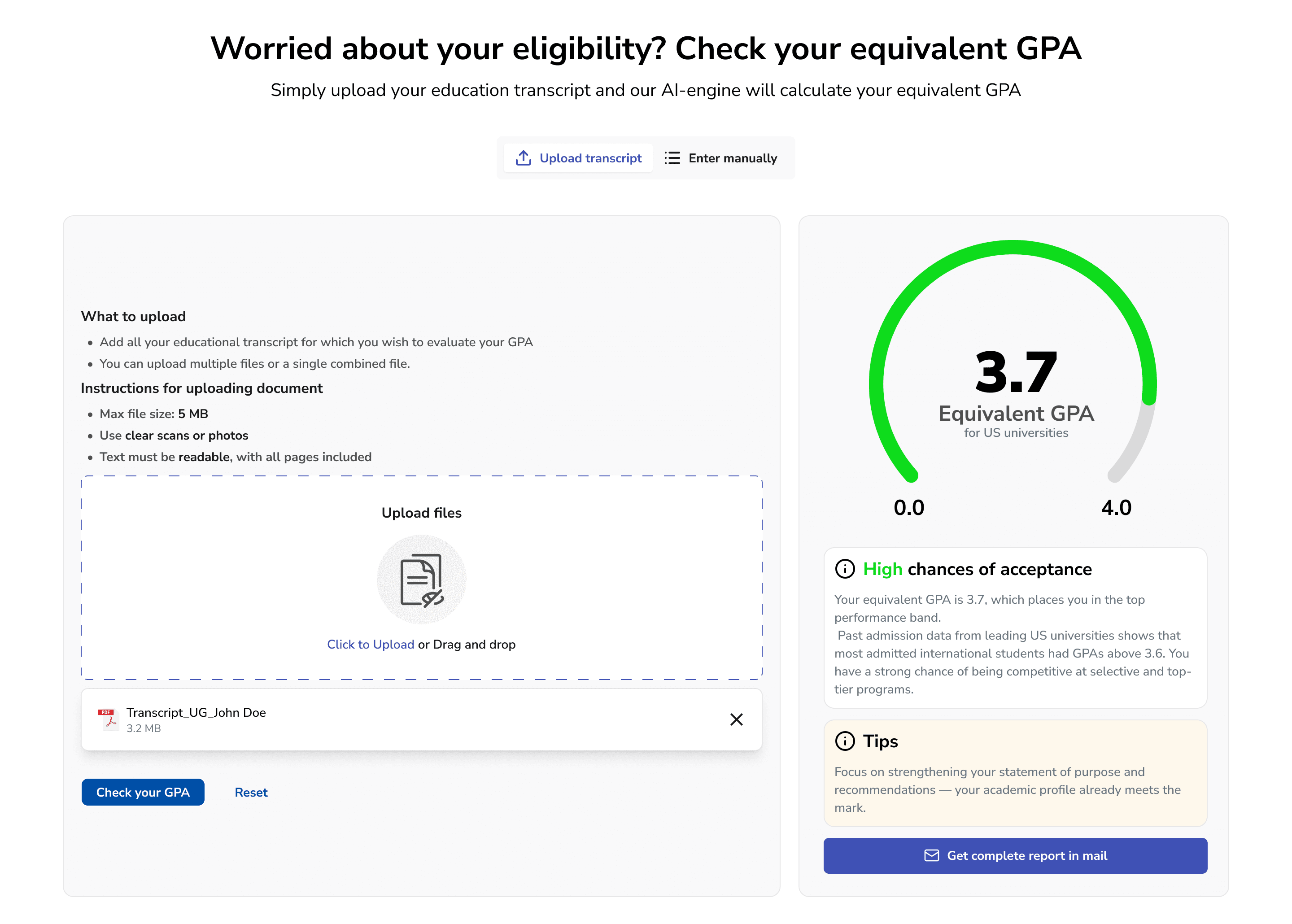
Student-facing GPA calculators are designed to provide informational estimates, not official evaluations. These tools typically rely on widely used grading scales and standardized mappings that reflect common academic practices. They do not apply institution-specific rules or custom grading interpretations, which are usually reserved for universities and professional evaluators.
As a result, GPA calculators are best used as a way for students to explore how their grades may be interpreted under common frameworks. They can help clarify expectations and support planning, but they should not be viewed as definitive or universally accepted results.
How GPA Is Typically Calculated
Although methodologies differ, GPA calculation usually follows a consistent conceptual process. Individual grades are first interpreted using a defined equivalency scale. Each grade is then assigned a corresponding grade point value. Courses are weighted according to their credit value, and these weighted grade points are combined to produce a cumulative GPA.
In many academic settings, GPA is calculated on a course-by-course basis, meaning each subject contributes proportionally to the final result. This approach provides a more detailed picture of academic performance than methods that rely solely on overall averages.
Student-facing GPA calculators are designed to provide informational estimates, not official evaluations. These tools typically rely on widely used grading scales and standardized mappings that reflect common academic practices. They do not apply institution-specific rules or custom grading interpretations, which are usually reserved for universities and professional evaluators.
As a result, GPA calculators are best used as a way for students to explore how their grades may be interpreted under common frameworks. They can help clarify expectations and support planning, but they should not be viewed as definitive or universally accepted results.
Calculating GPA Step by Step
Understanding the logic behind GPA calculation makes the process feel less opaque.
1. Converting grades to grade points
Letter grades, numerical marks, or percentages are mapped to standardized grade point values. On a commonly used 4.0 scale, higher academic achievement corresponds to higher grade points. The mapping used is often called an equivalency scale as well. This choice is critical as different scales will produce different equivalent GPAs.
2. Accounting for course credits
A course with more credit hours has a larger impact on the final GPA than a course with fewer credits.
3. Calculating weighted grade points
Multiplying equivalent grade points by credits determines each course’s contribution.
4. Combining everything into an equivalent cumulative GPA
Adding the weighted points and dividing by total credits yields an overall measure of performance – the equivalent GPA
Calculating GPA Step by Step
Understanding the logic behind GPA calculation makes the process feel less opaque.
1. Converting grades to grade points
Letter grades, numerical marks, or percentages are mapped to standardized grade point values. On a commonly used 4.0 scale, higher academic achievement corresponds to higher grade points. The mapping used is often called an equivalency scale as well. This choice is critical as different scales will produce different equivalent GPAs.
2. Accounting for course credits
A course with more credit hours has a larger impact on the final GPA than a course with fewer credits.
3. Calculating weighted grade points
Multiplying equivalent grade points by credits determines each course’s contribution.
4. Combining everything into an equivalent cumulative GPA
Adding the weighted points and dividing by total credits yields an overall measure of performance – the equivalent GPA
Why GPA Equivalence Can Vary Across Institutions
There is no universally mandated method for converting grades from one system into another. Institutions often adopt equivalency tables or policies informed by their own experience with applicants from different educational backgrounds. As a result, two universities might interpret the same transcript slightly differently.
Because of this, GPA estimates generated through general-purpose tools should be viewed as informational rather than definitive. They help students understand how their grades align with commonly used scales, but official assessments always rest with the receiving institution.
Why GPA Equivalence Can Vary Across Institutions
There is no universally mandated method for converting grades from one system into another. Institutions often adopt equivalency tables or policies informed by their own experience with applicants from different educational backgrounds. As a result, two universities might interpret the same transcript slightly differently.
Because of this, GPA estimates generated through general-purpose tools should be viewed as informational rather than definitive. They help students understand how their grades align with commonly used scales, but official assessments always rest with the receiving institution.
Final Thoughts
GPA equivalence provides a meaningful way to interpret academic performance across diverse grading systems. While no conversion method can perfectly reflect the nuances of every educational context, understanding how GPA is calculated and helps students navigate application requirements more confidently.
By approaching GPA as part of a broader academic profile and using tools thoughtfully, students can gain clarity about where they stand and what steps they may want to take next.
Final Thoughts
GPA equivalence provides a meaningful way to interpret academic performance across diverse grading systems. While no conversion method can perfectly reflect the nuances of every educational context, understanding how GPA is calculated and helps students navigate application requirements more confidently.
By approaching GPA as part of a broader academic profile and using tools thoughtfully, students can gain clarity about where they stand and what steps they may want to take next.