
Outsourced Credential Evaluation Has Outlived Its Purpose

Dev Srivastava
Part 1 of 2 — Part 2 covers the operational pathway to bringing evaluation in-house.
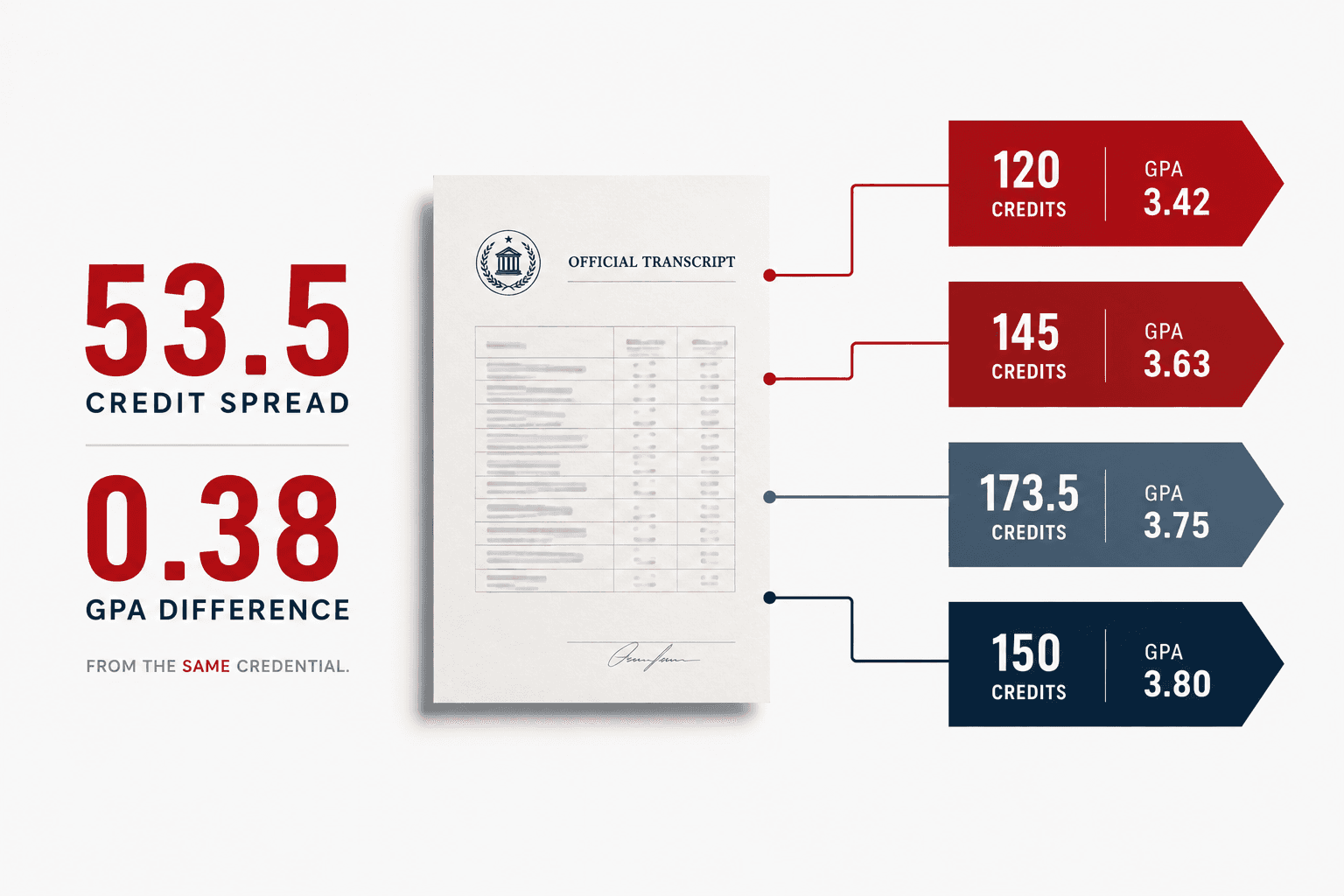
TL;DR: Four accredited NACES evaluators given identical transcripts from IIT Kanpur and Bocconi University produced a 53.5-credit spread on a single credential — nearly two full US academic years — and a 0.38 GPA spread on the same record. This is not a quality-control failure: the industry's accreditation model certifies process, not outcomes, and the accrediting body's own published guidance confirms that conclusions can legitimately differ between members. The result is structural variance, opaque conversion logic, applicant evaluator-shopping, and a $600–1,000 pre-application cost stack that quietly costs universities international candidates. AI-augmented document processing and modern credential evaluation software have eroded the original case for outsourcing. In-house credential evaluation — supported by platforms that handle document classification, fraud detection, and scale application — produces consistency, calibration, transparency, and faster turnaround, while keeping institutional judgment where it belongs.
Part 1 of 2 — Part 2 covers the operational pathway to bringing evaluation in-house.
TL;DR: Four accredited NACES evaluators given identical transcripts from IIT Kanpur and Bocconi University produced a 53.5-credit spread on a single credential — nearly two full US academic years — and a 0.38 GPA spread on the same record. This is not a quality-control failure: the industry's accreditation model certifies process, not outcomes, and the accrediting body's own published guidance confirms that conclusions can legitimately differ between members. The result is structural variance, opaque conversion logic, applicant evaluator-shopping, and a $600–1,000 pre-application cost stack that quietly costs universities international candidates. AI-augmented document processing and modern credential evaluation software have eroded the original case for outsourcing. In-house credential evaluation — supported by platforms that handle document classification, fraud detection, and scale application — produces consistency, calibration, transparency, and faster turnaround, while keeping institutional judgment where it belongs.
Two Transcripts, Four Evaluators, A 53-Credit Spread
Take one candidate. Two credentials on the transcript — IIT Kanpur and Bocconi University, institutions that sit among the most globally recognised and thoroughly documented in their respective regions. Send those documents to four of the reputable accredited evaluators that universities most commonly rely on and wait for the results.
Credit conversion for the IIT Kanpur credential comes back at 153, 157.5, 166.25, and 206.5 across the four evaluators. A spread of 53.5 credits — and at 30 credits to a full-time US academic year, that gap is nearly two years of coursework — produced from a single transcript. GPA conversions range from 3.47 to 3.85, a 0.38 spread: more than the distance between a B+ and an A- average. The downstream effects are immense as such a difference would impact scholarship eligibility, graduate programme thresholds, and competitive positioning in a selective admissions round.
The equivalency statements diverge just as sharply: one returned a generic "Bachelor's and master's degree" with no field specified, two gave degrees with the fields, while one gave different fields of study and described the standalone Bocconi master's as a bachelor's and master's combined (on outlier with the rest) — four evaluators, four different readings of the same documents. The latest completion date arrived roughly seven weeks after the earliest.
Given the same candidate and same documents, four accredited evaluations by prominent, widely used evaluators end up with significant differences in the results — from equivalence summaries to equivalent credit and GPA recalculations. The disagreement is not confined to the numbers; the evaluators could not even agree on how to describe the degrees.
This is an internal comparison conducted at TruEnroll on a deliberately favourable example. IIT Kanpur and Bocconi were chosen because they are among the most extensively documented institutions in their regions. A single comparison does not establish a pattern by itself. It does, however, converge with what international applicant communities have documented for years — forum threads where the same transcript routinely yields materially different outcomes across evaluators. Individual anecdotes prove little, and one controlled comparison proves little; the convergence between them is harder to dismiss.
If even institutions this well documented produce a 53-credit spread in credit conversion and a 0.38 GPA spread, the question worth asking is what happens further down the documentation curve: regional universities in Vietnam, state colleges across Nigeria, polytechnics in India, post-reform institutions in Eastern Europe and Central Asia. Those are exactly the markets where the international applicant pool is growing.
Two Transcripts, Four Evaluators, A 53-Credit Spread
Take one candidate. Two credentials on the transcript — IIT Kanpur and Bocconi University, institutions that sit among the most globally recognised and thoroughly documented in their respective regions. Send those documents to four of the reputable accredited evaluators that universities most commonly rely on and wait for the results.
Credit conversion for the IIT Kanpur credential comes back at 153, 157.5, 166.25, and 206.5 across the four evaluators. A spread of 53.5 credits — and at 30 credits to a full-time US academic year, that gap is nearly two years of coursework — produced from a single transcript. GPA conversions range from 3.47 to 3.85, a 0.38 spread: more than the distance between a B+ and an A- average. The downstream effects are immense as such a difference would impact scholarship eligibility, graduate programme thresholds, and competitive positioning in a selective admissions round.
The equivalency statements diverge just as sharply: one returned a generic "Bachelor's and master's degree" with no field specified, two gave degrees with the fields, while one gave different fields of study and described the standalone Bocconi master's as a bachelor's and master's combined (on outlier with the rest) — four evaluators, four different readings of the same documents. The latest completion date arrived roughly seven weeks after the earliest.
Given the same candidate and same documents, four accredited evaluations by prominent, widely used evaluators end up with significant differences in the results — from equivalence summaries to equivalent credit and GPA recalculations. The disagreement is not confined to the numbers; the evaluators could not even agree on how to describe the degrees.
This is an internal comparison conducted at TruEnroll on a deliberately favourable example. IIT Kanpur and Bocconi were chosen because they are among the most extensively documented institutions in their regions. A single comparison does not establish a pattern by itself. It does, however, converge with what international applicant communities have documented for years — forum threads where the same transcript routinely yields materially different outcomes across evaluators. Individual anecdotes prove little, and one controlled comparison proves little; the convergence between them is harder to dismiss.
If even institutions this well documented produce a 53-credit spread in credit conversion and a 0.38 GPA spread, the question worth asking is what happens further down the documentation curve: regional universities in Vietnam, state colleges across Nigeria, polytechnics in India, post-reform institutions in Eastern Europe and Central Asia. Those are exactly the markets where the international applicant pool is growing.
Why Outsourcing Credential Evaluation Made Sense — And Why It Doesn't Now
Foreign credential evaluation became standard practice when the logic for outsourcing it was sound. Academic records arrived on paper in languages requiring specialist manual translation. Verifying an institution's accreditation status meant written correspondence across time zones. Extracting structured data from a handwritten or typewritten document took time few admissions offices could absorb. Expertise in foreign grading systems was scarce and took years to build. Outsourcing was a rational response.
Most of those constraints have substantially eroded — through AI-augmented document processing, multilingual extraction, accessible international academic databases, and automation at scale. The practice didn't evolve with the technology. What remains is a system whose structural features — variance by design, no enforcement on outcomes, opaque conversion logic — are imposing real costs on universities and applicants that the original justification can no longer absorb.
A scope note before going further. Evaluations from these accredited services are still required by USCIS for several visa categories, by some state licensing boards, and by professional accreditation bodies. Those external requirements are not what this piece is about. The argument here concerns admissions decisions, where the institution itself is the consumer of the evaluation. Universities can bring admissions evaluation in-house without affecting their applicants' ability to obtain an accredited evaluation for any external purpose that still requires one.
Why Do Accredited Credential Evaluations Produce Different Results?
Accredited evaluators can legitimately reach different conclusions on the same transcript because the industry's accreditation model certifies process and professional ethics, not outcomes. The accrediting body's own published guidance is explicit: it does not dictate evaluation conclusions, and professional judgments can differ from one accredited member to another. Independent reference sources describing the accreditation framework confirm the same point: members are not required to evaluate credentials in a consistent manner.
The oversight body for the credential evaluation industry has acknowledged, in its own documentation, that two accredited members reviewing the same transcript can legitimately reach different conclusions. The system contains no mechanism to reconcile those differences after the fact.
The market dynamics surrounding that fact are worth naming directly. Applicants can choose their evaluator. Evaluators compete for those applicants. In a market where outcomes legitimately differ along a range and the buyer can shop, commercial pressure subtly rewards generosity within reputational limits. No enforcement actions on evaluation outcomes are publicly documented; whatever upward drift exists across the industry has no visible corrective mechanism. The point is not that any specific evaluator is being systematically generous — the point is that the system as designed has no mechanism preventing it from being so.
Why Outsourcing Credential Evaluation Made Sense — And Why It Doesn't Now
Foreign credential evaluation became standard practice when the logic for outsourcing it was sound. Academic records arrived on paper in languages requiring specialist manual translation. Verifying an institution's accreditation status meant written correspondence across time zones. Extracting structured data from a handwritten or typewritten document took time few admissions offices could absorb. Expertise in foreign grading systems was scarce and took years to build. Outsourcing was a rational response.
Most of those constraints have substantially eroded — through AI-augmented document processing, multilingual extraction, accessible international academic databases, and automation at scale. The practice didn't evolve with the technology. What remains is a system whose structural features — variance by design, no enforcement on outcomes, opaque conversion logic — are imposing real costs on universities and applicants that the original justification can no longer absorb.
A scope note before going further. Evaluations from these accredited services are still required by USCIS for several visa categories, by some state licensing boards, and by professional accreditation bodies. Those external requirements are not what this piece is about. The argument here concerns admissions decisions, where the institution itself is the consumer of the evaluation. Universities can bring admissions evaluation in-house without affecting their applicants' ability to obtain an accredited evaluation for any external purpose that still requires one.
Why Do Accredited Credential Evaluations Produce Different Results?
Accredited evaluators can legitimately reach different conclusions on the same transcript because the industry's accreditation model certifies process and professional ethics, not outcomes. The accrediting body's own published guidance is explicit: it does not dictate evaluation conclusions, and professional judgments can differ from one accredited member to another. Independent reference sources describing the accreditation framework confirm the same point: members are not required to evaluate credentials in a consistent manner.
The oversight body for the credential evaluation industry has acknowledged, in its own documentation, that two accredited members reviewing the same transcript can legitimately reach different conclusions. The system contains no mechanism to reconcile those differences after the fact.
The market dynamics surrounding that fact are worth naming directly. Applicants can choose their evaluator. Evaluators compete for those applicants. In a market where outcomes legitimately differ along a range and the buyer can shop, commercial pressure subtly rewards generosity within reputational limits. No enforcement actions on evaluation outcomes are publicly documented; whatever upward drift exists across the industry has no visible corrective mechanism. The point is not that any specific evaluator is being systematically generous — the point is that the system as designed has no mechanism preventing it from being so.
What Credential Evaluation Variance Costs Admissions Operationally
The variance problem has three operational consequences that reinforce each other: invisible methodological inconsistency, evaluation delays that cost enrollments, and duplicative internal review.
In any admissions cycle handling meaningful international volume, files arrive having been evaluated by different services applying different conversion methodologies on different timelines. The committee compares one evaluator's interpretation of an Indian transcript against another evaluator's interpretation of a South Korean or Nigerian one, and treats the resulting numbers as commensurable because they share a unit — GPA. They do not share a methodology. What presents as a comparative admissions review is, in practice, a comparison of several different organisations' proprietary interpretations of several different transcripts. The committee has no visibility into which conversion choices produced which number, no way to audit the logic, and no basis for correcting the inconsistency. The apples-to-oranges problem is invisible precisely because all the outputs look the same.
Turnaround creates a separate and measurable cost. Standard processing timelines advertised by major evaluators routinely understate actual completion times; six-to-ten-week realities behind seven-business-day promises are well-documented. Indian credential cases have in documented instances run to five months. International candidates don't suspend their applications while waiting — they're managing competing offers, visa decision windows, and financial aid timelines simultaneously. A credential evaluation delay can force an early commitment to a competing institution or cause the candidate to miss the window altogether. The university absorbs that enrollment loss without ever seeing it as a decision point, because by the time the evaluation arrives, the candidate has moved on.
Then there is the dual-review dynamic. Many universities require external evaluation and then conduct internal academic review on top of it. The conventional rationale is layered defence — two independent looks catch more than one. It is a reasonable instinct, but it is worth pressing on. If the external evaluation is sufficient on its own, the internal review is duplicative effort. If the internal review is genuinely necessary to contextualise or validate the external report, the external report's value is narrower than its mandatory status implies. The question most institutions never ask is what the combination produces that either step would not produce alone — and whether the answer justifies the cost on both sides.
How Mandatory Third-Party Evaluation Affects the Applicant Pool
The current system distorts the applicant pool on both ends: better-resourced applicants can shop evaluators for favourable outcomes, and budget-constrained applicants avoid institutions that require pre-application evaluation entirely.
Because the accreditation framework permits outcome differences by design, applicants who can afford multiple evaluations can shop evaluators and submit the most favourable result. This is not hypothetical — communities of international applicants already treat it as common knowledge, openly discussing which evaluators tend to produce higher GPAs and documenting individual cases where the same transcript yielded materially different results across evaluators. The behaviour is rational given how the system is constituted.
The institutional problem is that this is invisible at the point of decision. The admissions reader has no way to distinguish a single-attempt evaluation from a shopped-and-selected one. A first-generation international applicant submitting their first evaluation competes against a better-resourced applicant who selected the most favourable result from three attempts, and the committee cannot see the difference. The data integrity problem and the equity problem are the same problem viewed from different angles.
The friction cost cuts from the other direction. The full cost stack for an international applicant facing mandatory pre-application evaluation — base course-by-course evaluation around $160–200, rush service when timelines demand it, per-institution sending fees, courier for physical documents, and translation for non-English records — clears $600–1,000 per cycle before application fees, language tests, GRE, or visa costs. An applicant managing budget constraints can quietly redirect their applications toward institutions that don't impose this gate. The university never sees this as attrition because the applicant never appears in any funnel. It registers as absence rather than withdrawal, which is precisely why it rarely prompts a response.
Competition for strong international candidates has intensified considerably, with Canadian, UK, and Australian institutions positioning aggressively on applicant experience. Mandatory pre-application evaluation is friction at the most expensive point in the recruitment funnel — the point where candidates are still deciding whether to engage.
What Credential Evaluation Variance Costs Admissions Operationally
The variance problem has three operational consequences that reinforce each other: invisible methodological inconsistency, evaluation delays that cost enrollments, and duplicative internal review.
In any admissions cycle handling meaningful international volume, files arrive having been evaluated by different services applying different conversion methodologies on different timelines. The committee compares one evaluator's interpretation of an Indian transcript against another evaluator's interpretation of a South Korean or Nigerian one, and treats the resulting numbers as commensurable because they share a unit — GPA. They do not share a methodology. What presents as a comparative admissions review is, in practice, a comparison of several different organisations' proprietary interpretations of several different transcripts. The committee has no visibility into which conversion choices produced which number, no way to audit the logic, and no basis for correcting the inconsistency. The apples-to-oranges problem is invisible precisely because all the outputs look the same.
Turnaround creates a separate and measurable cost. Standard processing timelines advertised by major evaluators routinely understate actual completion times; six-to-ten-week realities behind seven-business-day promises are well-documented. Indian credential cases have in documented instances run to five months. International candidates don't suspend their applications while waiting — they're managing competing offers, visa decision windows, and financial aid timelines simultaneously. A credential evaluation delay can force an early commitment to a competing institution or cause the candidate to miss the window altogether. The university absorbs that enrollment loss without ever seeing it as a decision point, because by the time the evaluation arrives, the candidate has moved on.
Then there is the dual-review dynamic. Many universities require external evaluation and then conduct internal academic review on top of it. The conventional rationale is layered defence — two independent looks catch more than one. It is a reasonable instinct, but it is worth pressing on. If the external evaluation is sufficient on its own, the internal review is duplicative effort. If the internal review is genuinely necessary to contextualise or validate the external report, the external report's value is narrower than its mandatory status implies. The question most institutions never ask is what the combination produces that either step would not produce alone — and whether the answer justifies the cost on both sides.
How Mandatory Third-Party Evaluation Affects the Applicant Pool
The current system distorts the applicant pool on both ends: better-resourced applicants can shop evaluators for favourable outcomes, and budget-constrained applicants avoid institutions that require pre-application evaluation entirely.
Because the accreditation framework permits outcome differences by design, applicants who can afford multiple evaluations can shop evaluators and submit the most favourable result. This is not hypothetical — communities of international applicants already treat it as common knowledge, openly discussing which evaluators tend to produce higher GPAs and documenting individual cases where the same transcript yielded materially different results across evaluators. The behaviour is rational given how the system is constituted.
The institutional problem is that this is invisible at the point of decision. The admissions reader has no way to distinguish a single-attempt evaluation from a shopped-and-selected one. A first-generation international applicant submitting their first evaluation competes against a better-resourced applicant who selected the most favourable result from three attempts, and the committee cannot see the difference. The data integrity problem and the equity problem are the same problem viewed from different angles.
The friction cost cuts from the other direction. The full cost stack for an international applicant facing mandatory pre-application evaluation — base course-by-course evaluation around $160–200, rush service when timelines demand it, per-institution sending fees, courier for physical documents, and translation for non-English records — clears $600–1,000 per cycle before application fees, language tests, GRE, or visa costs. An applicant managing budget constraints can quietly redirect their applications toward institutions that don't impose this gate. The university never sees this as attrition because the applicant never appears in any funnel. It registers as absence rather than withdrawal, which is precisely why it rarely prompts a response.
Competition for strong international candidates has intensified considerably, with Canadian, UK, and Australian institutions positioning aggressively on applicant experience. Mandatory pre-application evaluation is friction at the most expensive point in the recruitment funnel — the point where candidates are still deciding whether to engage.
What In-House Credential Evaluation Enables
In-house credential evaluation gives universities four things outsourced evaluation cannot: full-file context, calibration to institutional grading culture, transparent conversion logic, and turnaround in hours or days rather than weeks.
External evaluators see the transcript. Universities have the full candidate file — statement of purpose, research history, recommendations, work experience, departmental feedback, and the institutional knowledge that comes from years of reading applicants from particular regions and institutions. A 3.47 from IIT Kanpur's notoriously stringent grading culture carries different predictive weight than a 3.47 from a less demanding institution, and experienced admissions readers know this implicitly. External reports strip that context and deliver a decontextualised number the committee then has to re-contextualise manually. In-house evaluation lets institutional judgment be applied with the context already present rather than despite its absence.
The calibration argument is more specific than it first appears. External reports hand you a converted GPA — the endpoint of a process applied to individual course grades, credit weights, grading scale calibrations, and classification decisions. Predictive analytics run on that output can establish whether it correlates with outcomes at your institution; they cannot identify which part of the conversion is generating signal or noise because the methodology sits inside the vendor's system, inaccessible and unadjustable. The most a university can do is apply a correction factor at the output — treat IITK's converted 3.6 as your institution's 3.8, for example. In-house evaluation changes the structure of that problem. Conversion parameters live inside your system. The feedback loop closes: convert, track outcomes, adjust the specific scale parameters for a given sending institution, convert more accurately next cycle. Calibration happens at the source rather than as a correction layer applied downstream. Over several cycles, for the institutions sending consistent applicant volumes, those scales compound into something genuinely predictive rather than generically standardised.
The expertise compounding argument follows similar logic but lands differently. The value is not in evaluating IIT Kanpur or Bocconi — those are cases any careful evaluator handles reasonably well. It accumulates in the long tail: regional sending institutions in growing markets where third-party documentation is limited, credential systems that changed significantly through educational reform, institutions where the gap between international reputation and actual grading practice is wide. External evaluators have limited incentive to develop deep expertise in low-volume edge cases. An institution that regularly receives applicants from specific regional senders builds that expertise over time through the people making evaluation decisions, and the accuracy improvement compounds precisely where accuracy currently matters most and is currently least reliable.
A reasonable counter at this point is that in-house evaluation has its own variance problem — different readers, different departments, different cycles. The relevant distinction is architectural. Variance across independent external members is permitted by design and has no reconciliation mechanism. Variance inside an institution is a process problem the institution controls. Consistency is not automatic when evaluation is brought in-house — it requires shared methodology, training, and calibration over time. Credential evaluation software designed for in-house use accelerates this work substantially: standardised conversion scales applied uniformly across readers, auto-recommendations that establish a methodological baseline before individual judgment enters the picture, and audit trails that make inconsistencies visible and correctable. Good policy and implementation are still required. The point is that consistency is achievable inside an institution in a way it structurally is not across a field of independent external evaluators.
Concretely, in-house credential evaluation done well produces: consistency within an admissions cycle because the same methodology applies to every applicant; conversion scales calibrated to institutional and departmental grading culture; transparent conversion logic that can be explained to candidates, auditors, or appeals processes; turnaround in hours or days rather than weeks; fraud detection informed by patterns across the institution's own applicant history; integration with the SIS and admissions workflow rather than a parallel external process; and no mandatory pre-application cost imposed on the candidates the institution is actively competing for.
This is established practice with established support infrastructure. AACRAO has long provided credential evaluation guidance and frameworks for institutions doing this work internally. TAICEP — The Association for International Credential Evaluation Professionals — operates as a working community for in-house evaluators sharing methodologies, case approaches, and institutional knowledge. In-house credential evaluation is not a fringe position or an improvised alternative.
Whose Decision Is This, Really?
Credits awarded, GPA computed, degree level assigned, field of study classified — these determinations flow downstream into scholarship eligibility, academic standing, transfer credit decisions, graduate programme thresholds, and accreditation reporting. They are institutional decisions in every meaningful sense. The conversion frameworks producing them are proprietary decisions made by external organisations operating under accreditation that explicitly permits inconsistency across those organisations.
Most universities never consciously decided to delegate this. The practice accumulated by default during a period when building in-house capability was genuinely impractical. At some point, accepting that a vendor's proprietary framework defines what a credential is worth at your institution — without the ability to audit the logic, calibrate to your own standards, or ensure consistency across your own applicant pool — becomes a choice, even if it was never made deliberately.
What In-House Credential Evaluation Enables
In-house credential evaluation gives universities four things outsourced evaluation cannot: full-file context, calibration to institutional grading culture, transparent conversion logic, and turnaround in hours or days rather than weeks.
External evaluators see the transcript. Universities have the full candidate file — statement of purpose, research history, recommendations, work experience, departmental feedback, and the institutional knowledge that comes from years of reading applicants from particular regions and institutions. A 3.47 from IIT Kanpur's notoriously stringent grading culture carries different predictive weight than a 3.47 from a less demanding institution, and experienced admissions readers know this implicitly. External reports strip that context and deliver a decontextualised number the committee then has to re-contextualise manually. In-house evaluation lets institutional judgment be applied with the context already present rather than despite its absence.
The calibration argument is more specific than it first appears. External reports hand you a converted GPA — the endpoint of a process applied to individual course grades, credit weights, grading scale calibrations, and classification decisions. Predictive analytics run on that output can establish whether it correlates with outcomes at your institution; they cannot identify which part of the conversion is generating signal or noise because the methodology sits inside the vendor's system, inaccessible and unadjustable. The most a university can do is apply a correction factor at the output — treat IITK's converted 3.6 as your institution's 3.8, for example. In-house evaluation changes the structure of that problem. Conversion parameters live inside your system. The feedback loop closes: convert, track outcomes, adjust the specific scale parameters for a given sending institution, convert more accurately next cycle. Calibration happens at the source rather than as a correction layer applied downstream. Over several cycles, for the institutions sending consistent applicant volumes, those scales compound into something genuinely predictive rather than generically standardised.
The expertise compounding argument follows similar logic but lands differently. The value is not in evaluating IIT Kanpur or Bocconi — those are cases any careful evaluator handles reasonably well. It accumulates in the long tail: regional sending institutions in growing markets where third-party documentation is limited, credential systems that changed significantly through educational reform, institutions where the gap between international reputation and actual grading practice is wide. External evaluators have limited incentive to develop deep expertise in low-volume edge cases. An institution that regularly receives applicants from specific regional senders builds that expertise over time through the people making evaluation decisions, and the accuracy improvement compounds precisely where accuracy currently matters most and is currently least reliable.
A reasonable counter at this point is that in-house evaluation has its own variance problem — different readers, different departments, different cycles. The relevant distinction is architectural. Variance across independent external members is permitted by design and has no reconciliation mechanism. Variance inside an institution is a process problem the institution controls. Consistency is not automatic when evaluation is brought in-house — it requires shared methodology, training, and calibration over time. Credential evaluation software designed for in-house use accelerates this work substantially: standardised conversion scales applied uniformly across readers, auto-recommendations that establish a methodological baseline before individual judgment enters the picture, and audit trails that make inconsistencies visible and correctable. Good policy and implementation are still required. The point is that consistency is achievable inside an institution in a way it structurally is not across a field of independent external evaluators.
Concretely, in-house credential evaluation done well produces: consistency within an admissions cycle because the same methodology applies to every applicant; conversion scales calibrated to institutional and departmental grading culture; transparent conversion logic that can be explained to candidates, auditors, or appeals processes; turnaround in hours or days rather than weeks; fraud detection informed by patterns across the institution's own applicant history; integration with the SIS and admissions workflow rather than a parallel external process; and no mandatory pre-application cost imposed on the candidates the institution is actively competing for.
This is established practice with established support infrastructure. AACRAO has long provided credential evaluation guidance and frameworks for institutions doing this work internally. TAICEP — The Association for International Credential Evaluation Professionals — operates as a working community for in-house evaluators sharing methodologies, case approaches, and institutional knowledge. In-house credential evaluation is not a fringe position or an improvised alternative.
Whose Decision Is This, Really?
Credits awarded, GPA computed, degree level assigned, field of study classified — these determinations flow downstream into scholarship eligibility, academic standing, transfer credit decisions, graduate programme thresholds, and accreditation reporting. They are institutional decisions in every meaningful sense. The conversion frameworks producing them are proprietary decisions made by external organisations operating under accreditation that explicitly permits inconsistency across those organisations.
Most universities never consciously decided to delegate this. The practice accumulated by default during a period when building in-house capability was genuinely impractical. At some point, accepting that a vendor's proprietary framework defines what a credential is worth at your institution — without the ability to audit the logic, calibrate to your own standards, or ensure consistency across your own applicant pool — becomes a choice, even if it was never made deliberately.
Why The Case For In-House Credential Evaluation Has Changed Now
The case for outsourcing rested on conditions that were real: paper transcripts, manual translation, no programmatic way to verify institutional accreditation, and the genuine scarcity of people who understood foreign grading systems well enough to convert them accurately. Make versus buy pointed clearly toward buy.
Several of those conditions have substantially changed. AI-augmented document processing now extracts structured data from transcripts across Devanagari, Arabic, Cyrillic, and Chinese scripts with accuracy not operationally available five years ago. Institutional accreditation databases are queryable in ways that required manual correspondence a decade ago. Pattern-based fraud detection — identifying manipulated grades, inconsistent document metadata, fabricated institutional templates — is now applicable at the volumes admissions offices actually handle. The cross-institutional pattern visibility that gave large external evaluators an edge — seeing thousands of transcripts from the same sending institution, catching recurring fraud signals, tracking accreditation status changes — is the kind of work credential evaluation platforms can now consolidate as a layer underneath in-house evaluation rather than as a substitute for it.
A separate post [link] covers the technical shift in more detail. The headline: the operational work that once justified outsourcing is now largely automatable. What remains for human judgment is the part that requires institutional knowledge — edge cases, departmental calibration, contextual reading of the full candidate file. That is precisely what external evaluators handle least well.
This used to be a volume question — institutions with hundreds or thousands of international applications could justify in-house infrastructure; smaller programmes could not. Platform-assisted evaluation changes that equation. The bulk of cases at any institution can be handled through structured workflows that scale down as easily as up; the edge cases that genuinely require specialist judgment are a separable problem with separable solutions. Part 2 covers volume-specific strategies — including how smaller programmes can run in-house evaluation effectively without standing up a full credential evaluation function.
TruEnroll was built around this shift. The platform handles document classification, fraud detection, accreditation and qualification recognition, structured data extraction across 50+ languages, equivalency scale application, and report generation — consolidating the operational layer admissions offices previously had to outsource. The evaluation itself, informed by that structured output, stays where it belongs: inside the institution, with access to the full candidate file and the accumulated knowledge of the people making the decisions.
Frequently Asked Questions
Are accredited credential evaluations consistent across evaluators?
No. The industry's accreditation model certifies members on process and professional ethics, not on evaluation outcomes. The accrediting body's own published guidance explicitly states that conclusions can differ from one member to another, and members are not required to evaluate credentials in a consistent manner. Identical transcripts submitted to multiple accredited evaluators routinely produce materially different credit conversions, GPA calculations, and degree equivalency determinations.
Can a university stop requiring third-party evaluations for admissions?
Yes, for admissions purposes. Accredited evaluations remain required by external bodies — USCIS for certain visa categories, some state licensing boards, and professional accreditation organisations — but those requirements operate independently of admissions. A university can bring admissions credential evaluation in-house without affecting an applicant's ability to obtain an accredited evaluation when needed for an external purpose.
How long do third-party credential evaluations actually take?
Standard advertised timelines are typically seven business days. Actual completion times routinely run six to ten weeks, with documented cases extending to five months — particularly for credentials from India and other markets with high evaluation volume. Rush services exist but add significant cost and frequently still miss admissions deadlines.
What does a foreign credential evaluation cost an applicant?
The full cost stack — base course-by-course evaluation ($160–200), rush service fees, per-institution sending fees, courier for physical documents, and translation for non-English records — typically clears $600–1,000 per application cycle. This is before application fees, language tests (TOEFL/IELTS), graduate admissions tests, and visa costs.
Is in-house credential evaluation only feasible for large institutions?
This used to be true, but credential evaluation software has changed the equation. Platform-assisted evaluation handles the operational workload — document classification, structured data extraction, accreditation lookup, scale application, fraud detection — at any scale. The bulk of cases run through structured workflows; only genuine edge cases require deep specialist judgment. Institutions processing several dozen international applications a year can now operate in-house credential evaluation effectively.
What's the difference between in-house credential evaluation and using credential evaluation software?
These are complementary, not alternatives. Credential evaluation software (such as TruEnroll) handles the operational layer — document processing, data extraction, accreditation verification, scale application, fraud detection. In-house credential evaluation refers to the institution making the final evaluative determinations using that structured output, applying institutional context and judgment, rather than outsourcing the determination to a third-party evaluator. The platform replaces the operational work; the institution retains the judgment.
Where does third-party accreditation still matter if we bring evaluation in-house?
Three places: external regulatory requirements (USCIS, professional licensing) where the applicant's downstream needs require an accredited evaluation; genuinely complex edge cases where specialist evaluation may still be warranted; and as a reference point — the AACRAO and TAICEP frameworks that support in-house evaluation draw on the same underlying body of knowledge that accredited evaluators work from.
The decision to outsource credential evaluation was made implicitly by most universities, at a time when the alternatives were harder to build. The arguments for revisiting it are operational, strategic, and structural — and they have become more compelling as the original constraints have eroded.
Part 2 covers the practical transition: how universities phase in-house evaluation in without disruption, where specialist external evaluation still makes sense for genuinely complex cases, how AACRAO and TAICEP frameworks support the process, and how credential evaluation platforms like TruEnroll operate as the working layer underneath. The case for change is the easier half of this conversation. The implementation deserves more care, and that's what Part 2 is for.
Sources
https://forums.studentdoctor.net/threads/low-gpa.119225/post-1416221
https://forums.studentdoctor.net/threads/wes-evaluation.107994/post-1247507
https://talk.collegeconfidential.com/t/unfair-transcript-evaluation-warning/833259
https://forum.thegradcafe.com/topic/10350-how-will-us-universities-evaluate-your-foreign-degree/
https://www.canadavisa.com/canada-immigration-discussion-board/goto/post?id=7747844
https://discuss.settlement.org/topic43265-extremely-slow-servicecredential-evaluation.aspx
Why The Case For In-House Credential Evaluation Has Changed Now
The case for outsourcing rested on conditions that were real: paper transcripts, manual translation, no programmatic way to verify institutional accreditation, and the genuine scarcity of people who understood foreign grading systems well enough to convert them accurately. Make versus buy pointed clearly toward buy.
Several of those conditions have substantially changed. AI-augmented document processing now extracts structured data from transcripts across Devanagari, Arabic, Cyrillic, and Chinese scripts with accuracy not operationally available five years ago. Institutional accreditation databases are queryable in ways that required manual correspondence a decade ago. Pattern-based fraud detection — identifying manipulated grades, inconsistent document metadata, fabricated institutional templates — is now applicable at the volumes admissions offices actually handle. The cross-institutional pattern visibility that gave large external evaluators an edge — seeing thousands of transcripts from the same sending institution, catching recurring fraud signals, tracking accreditation status changes — is the kind of work credential evaluation platforms can now consolidate as a layer underneath in-house evaluation rather than as a substitute for it.
A separate post [link] covers the technical shift in more detail. The headline: the operational work that once justified outsourcing is now largely automatable. What remains for human judgment is the part that requires institutional knowledge — edge cases, departmental calibration, contextual reading of the full candidate file. That is precisely what external evaluators handle least well.
This used to be a volume question — institutions with hundreds or thousands of international applications could justify in-house infrastructure; smaller programmes could not. Platform-assisted evaluation changes that equation. The bulk of cases at any institution can be handled through structured workflows that scale down as easily as up; the edge cases that genuinely require specialist judgment are a separable problem with separable solutions. Part 2 covers volume-specific strategies — including how smaller programmes can run in-house evaluation effectively without standing up a full credential evaluation function.
TruEnroll was built around this shift. The platform handles document classification, fraud detection, accreditation and qualification recognition, structured data extraction across 50+ languages, equivalency scale application, and report generation — consolidating the operational layer admissions offices previously had to outsource. The evaluation itself, informed by that structured output, stays where it belongs: inside the institution, with access to the full candidate file and the accumulated knowledge of the people making the decisions.
Frequently Asked Questions
Are accredited credential evaluations consistent across evaluators?
No. The industry's accreditation model certifies members on process and professional ethics, not on evaluation outcomes. The accrediting body's own published guidance explicitly states that conclusions can differ from one member to another, and members are not required to evaluate credentials in a consistent manner. Identical transcripts submitted to multiple accredited evaluators routinely produce materially different credit conversions, GPA calculations, and degree equivalency determinations.
Can a university stop requiring third-party evaluations for admissions?
Yes, for admissions purposes. Accredited evaluations remain required by external bodies — USCIS for certain visa categories, some state licensing boards, and professional accreditation organisations — but those requirements operate independently of admissions. A university can bring admissions credential evaluation in-house without affecting an applicant's ability to obtain an accredited evaluation when needed for an external purpose.
How long do third-party credential evaluations actually take?
Standard advertised timelines are typically seven business days. Actual completion times routinely run six to ten weeks, with documented cases extending to five months — particularly for credentials from India and other markets with high evaluation volume. Rush services exist but add significant cost and frequently still miss admissions deadlines.
What does a foreign credential evaluation cost an applicant?
The full cost stack — base course-by-course evaluation ($160–200), rush service fees, per-institution sending fees, courier for physical documents, and translation for non-English records — typically clears $600–1,000 per application cycle. This is before application fees, language tests (TOEFL/IELTS), graduate admissions tests, and visa costs.
Is in-house credential evaluation only feasible for large institutions?
This used to be true, but credential evaluation software has changed the equation. Platform-assisted evaluation handles the operational workload — document classification, structured data extraction, accreditation lookup, scale application, fraud detection — at any scale. The bulk of cases run through structured workflows; only genuine edge cases require deep specialist judgment. Institutions processing several dozen international applications a year can now operate in-house credential evaluation effectively.
What's the difference between in-house credential evaluation and using credential evaluation software?
These are complementary, not alternatives. Credential evaluation software (such as TruEnroll) handles the operational layer — document processing, data extraction, accreditation verification, scale application, fraud detection. In-house credential evaluation refers to the institution making the final evaluative determinations using that structured output, applying institutional context and judgment, rather than outsourcing the determination to a third-party evaluator. The platform replaces the operational work; the institution retains the judgment.
Where does third-party accreditation still matter if we bring evaluation in-house?
Three places: external regulatory requirements (USCIS, professional licensing) where the applicant's downstream needs require an accredited evaluation; genuinely complex edge cases where specialist evaluation may still be warranted; and as a reference point — the AACRAO and TAICEP frameworks that support in-house evaluation draw on the same underlying body of knowledge that accredited evaluators work from.
The decision to outsource credential evaluation was made implicitly by most universities, at a time when the alternatives were harder to build. The arguments for revisiting it are operational, strategic, and structural — and they have become more compelling as the original constraints have eroded.
Part 2 covers the practical transition: how universities phase in-house evaluation in without disruption, where specialist external evaluation still makes sense for genuinely complex cases, how AACRAO and TAICEP frameworks support the process, and how credential evaluation platforms like TruEnroll operate as the working layer underneath. The case for change is the easier half of this conversation. The implementation deserves more care, and that's what Part 2 is for.
Sources
https://forums.studentdoctor.net/threads/low-gpa.119225/post-1416221
https://forums.studentdoctor.net/threads/wes-evaluation.107994/post-1247507
https://talk.collegeconfidential.com/t/unfair-transcript-evaluation-warning/833259
https://forum.thegradcafe.com/topic/10350-how-will-us-universities-evaluate-your-foreign-degree/
https://www.canadavisa.com/canada-immigration-discussion-board/goto/post?id=7747844
https://discuss.settlement.org/topic43265-extremely-slow-servicecredential-evaluation.aspx